
Last updated 8 October 2026
Yes, Home Building & Surveying Company (HBSC) offers a free damp survey if you own and live in the property and can be there for the appointment. Landlord, tenanted and commercial properties, and homeowners who cannot attend, need a paid survey, with the fee confirmed before booking and deductible if you go ahead with HBSC’s recommended work. Either way, the survey is there to find where the moisture is coming from, because condensation, leaks, rain getting in and rising damp each need a different fix.
| At a glance | Free damp survey | Paid damp survey |
|---|---|---|
| Who it is for | Owner occupiers who can be present at the appointment | Landlord, tenanted and commercial properties, and homeowners who cannot attend |
| Cost | Free | Fee confirmed before booking |
| What sets the fee | Not applicable | Survey type, property size, number of areas, location and access |
| Access | You are there on the day | Agreed in advance |
| If you go ahead with HBSC’s work | No survey fee to deduct | Survey fee is deductible from the recommended work |
Damp patches, peeling paint or mould that keeps returning can leave you wondering what is wrong. The answers below cover booking a survey with HBSC, what happens during it, and what happens after treatment.
Free and paid damp surveys
Can I get a free damp survey?
HBSC offers free damp surveys for owner occupiers who can be present at the appointment. If you own and live in your home, contact us with your postcode and details of the problem to check availability.
Landlord, tenanted and commercial properties require a paid survey. A paid option is also available for homeowners who cannot attend.
Why do homeowners need to be present?
Being there allows you to show the surveyor the affected areas, explain when the problem started and discuss the findings.
Details such as whether a patch appears after rain or mould gets worse in winter can help with the assessment. You can also ask questions and talk through the recommended next steps.
Do you offer damp surveys for landlords and tenanted properties?
Yes. HBSC offers paid surveys for landlords and tenanted properties.
Tell us about the property, the affected areas and what information you need from the survey. We can then explain the appropriate scope and confirm the fee before booking. Access arrangements should be agreed in advance.
The survey fee is deductible if you proceed with HBSC’s recommended work.
What if I own the property but cannot attend?
A paid survey is available for homeowners who cannot be present. Access must be arranged in advance.
The survey fee is deductible if you proceed with HBSC’s recommended work.
How much does a paid damp survey cost?
The fee depends on the survey type, property size, number of areas to inspect, location and access requirements. Commercial properties may require a different scope.
Contact HBSC with your property details and the reason for the inspection. We will explain the proposed survey and confirm the fee before booking.
The survey fee is deductible if you proceed with HBSC’s recommended work.
What happens during a damp survey?
What does a damp survey involve?
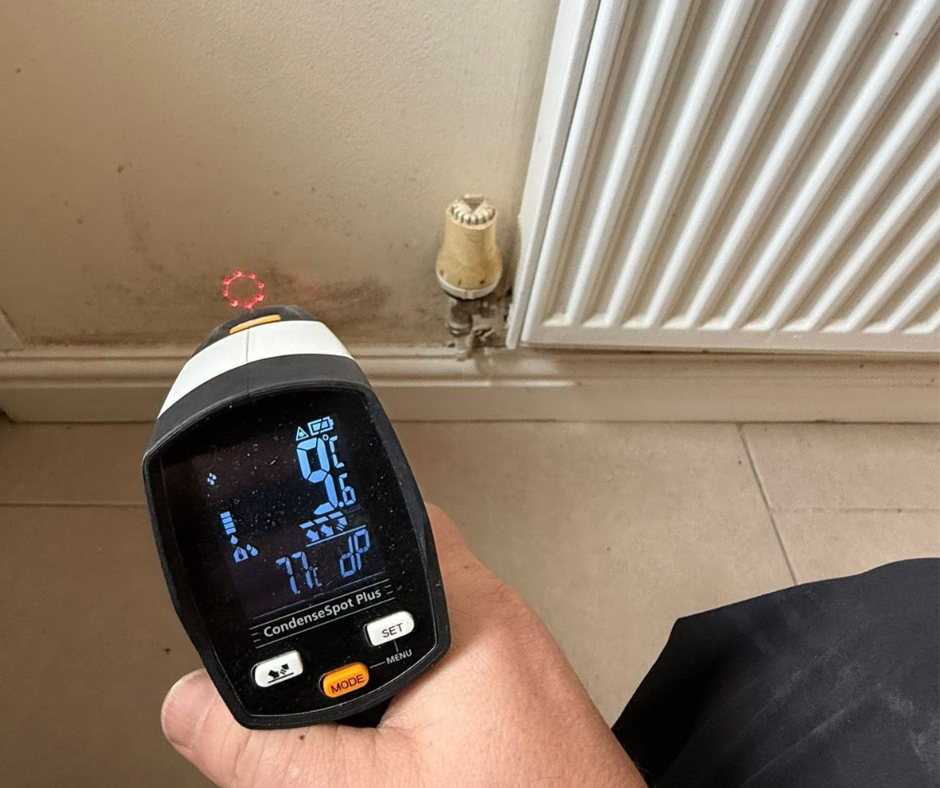
The surveyor assesses the reported problem and considers possible sources of moisture.
Depending on the agreed scope and access, checks can include affected surfaces, relevant external defects, ventilation and moisture readings.
The aim is to understand the cause and recommend suitable next steps. Sometimes further investigation is needed before a firm diagnosis can be made.
Can a damp meter prove that I have rising damp?
No. A high reading from an electrical moisture meter does not, by itself, establish rising damp.
Readings must be interpreted alongside the wall materials, visible signs, building condition and other evidence. Salts and some materials can affect readings, so a diagnosis should not rely on the meter alone.
RICS’s consumer guidance on damp and mould cautions against relying only on a damp meter to diagnose the source, particularly in hard walls and solid floors.
Will a survey automatically lead to damp proofing work?
No. The recommendation should depend on the cause.
A moisture problem might require a building repair, ventilation improvements, damp treatment or further investigation. A new damp proof course is not the answer to every damp wall.
Is a free damp survey an independent building survey?
No. HBSC is a survey and remedial works company. Our free homeowner survey is a commercial assessment that may lead to a quotation for suitable work.
If you need independent advice or a report for a dispute, explain this before booking so the appropriate service can be established.
Understanding damp and mould
How can I tell whether I have rising damp, condensation or a leak?
The location and timing can provide clues, but symptoms alone cannot confirm the cause. More than one source of moisture can affect a property.
Condensation
Common clues include water on windows and mould on cold surfaces or behind furniture. An assessment should consider ventilation, moisture sources, heating and cold surfaces.
Rainwater penetration
A damp patch that appears or worsens after wet weather may indicate rainwater entering the building. Gutters, roof defects, pointing, render and areas around windows and doors may need checking.
Plumbing leaks
A localised damp patch near pipework or an adjoining bathroom may suggest a plumbing leak. Water supply pipes, waste pipes and possible concealed leaks should be considered.
Rising damp
Dampness or deterioration near the bottom of a wall can be associated with rising damp, but other problems can produce similar signs. Checks should consider external ground levels, anything bridging the damp proof course and other possible moisture sources.
These signs provide clues rather than a confirmed diagnosis. An inspection helps establish the cause and the appropriate action.
Read more about HBSC’s condensation services and rising damp treatment.
Why does mould keep coming back after cleaning?
Cleaning removes visible mould, but it does not necessarily resolve the conditions allowing it to grow.
Recurring mould can be associated with condensation, cold surfaces, inadequate ventilation, leaks or other moisture sources. The next step is to establish which factors are affecting the property.
Find out more about HBSC’s mould remediation service.
Can condensation cause damp behind furniture?
Yes. Furniture close to a cold external wall can restrict airflow, contributing to conditions where condensation and mould develop.
Leaving space for air to circulate may help. Recurring problems also need consideration of ventilation, heating, insulation and other moisture sources.
What causes damp patches after heavy rain?
Possible causes include leaking gutters, damaged pointing, cracked render, roof defects and problems around windows.
Water can travel through a building, so the visible patch may not be directly beside the point where it enters. Establish the source before covering the patch or choosing a treatment.
Will a dehumidifier solve damp?
A dehumidifier can reduce moisture in the air and help manage some condensation problems. It does not repair a leaking roof, stop a plumbing leak or correct defects allowing rainwater into a building.
It can be useful as part of moisture management, but its suitability depends on the cause.
Does every damp wall need a new damp proof course?
No. Condensation, plumbing leaks and rainwater penetration require different solutions.
An existing damp proof course may also be bridged by raised external ground levels, render or other materials. This can allow moisture to bypass it.
Property Care Association guidance on rising damp treatment explains that removing a bridge may be sufficient where it is the cause.
The building and supporting evidence should be assessed before deciding on treatment.
Treatment and aftercare
Will damp treatment involve removing plaster?
Sometimes. Plaster may need replacing if it is damaged or affected by salts, but this depends on the findings and proposed treatment.
Where replacement is recommended, your quotation should explain the areas involved and the proposed plastering system.
How long does a wall take to dry after treatment?
There is no single drying time for every wall. Construction, thickness, initial moisture levels, finishes and conditions inside the property all matter.
Stopping the moisture source does not mean the wall becomes dry immediately. Follow the advice provided for your property and contact us if you are unsure about its progress.
When can I decorate after damp treatment?
This depends on the treatment, replacement plaster and drying conditions. Decorating too early or using an unsuitable finish can affect the result.
Follow the aftercare instructions provided for your work. If you are unsure whether the wall is ready, ask before painting or wallpapering.
What should I do if I am concerned after the work?
Contact HBSC and explain what you have noticed, when it appeared and whether it is changing.
Photographs can help the team understand your concern and advise on the next step.
Booking a damp survey with HBSC
Which areas does HBSC cover?
Home Building & Surveying Company is based in Bournemouth and offers nationwide coverage.
Contact us with your postcode to confirm availability for your location and the survey you need.
How do I arrange a damp survey?
Call 0333 006 4138 or complete our online enquiry form.
Tell us your postcode, whether you own and occupy the property, and what you have noticed. We will explain the available options and whether your appointment qualifies for a free survey or requires a paid inspection.
Get the cause checked
You do not need to know what type of damp you have before contacting us. Tell us what you are seeing, and we will help you arrange the appropriate assessment.
Free surveys are available for owner occupiers who can attend. For landlord, tenanted, commercial or unattended homeowner surveys, call 0333 006 4138 to discuss a paid inspection.
Further reading
- RICS: Damp and mould consumer guide
- Historic England: Investigating moisture in traditional buildings
- Property Care Association: Rising damp treatment guidance
These sources provide general technical guidance. References do not imply membership, accreditation or endorsement of HBSC. Older and traditionally constructed buildings may require specialist assessment suited to their materials and construction.


